

New Product Update: Advanced 96% Alumina Ceramic Substrates
Puwei proudly introduces our latest innovation in ceramic substrate technology – the Advanced 96% Alumina Ceramic Substrate.
Key Product Features and Technical Innovations
Advanced Manufacturing Capabilities
Our production facility leverages large-scale tape casting, high-temperature sintering, and advanced laser scribing equipment to achieve an annual output of 80,000 square meters. Beyond standard large-format sheets, we provide comprehensive custom machining services to meet specific dimensional requirements for custom ceramic substrates used in specialized applications.
Proprietary Iron Removal Technology
One critical challenge in Al2O3 ceramic substrate manufacturing is iron-containing oxide impurities that form red spots during high-temperature sintering. These imperfections not only affect aesthetics but severely compromise electrical properties. Our proprietary process reduces iron oxide impurities by over 95%, significantly enhancing volume resistivity and breakdown voltage – crucial for power device ceramic substrates and high-frequency applications.
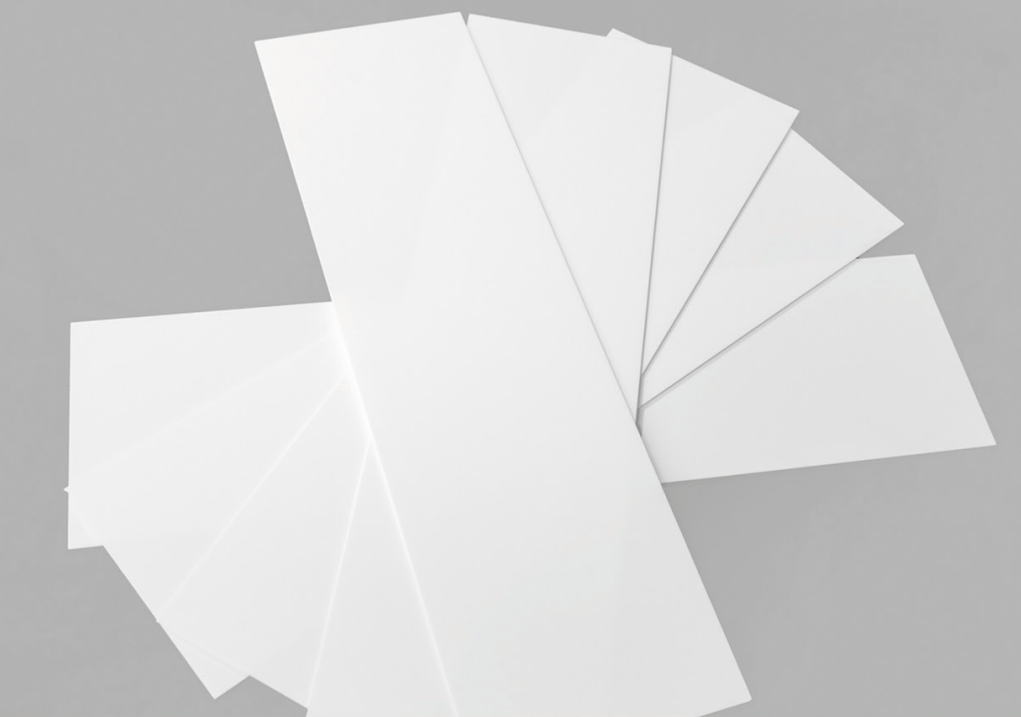
Our advanced 96% alumina ceramic substrate exhibits minimal warpage and superior surface quality
Superior Warpage Control
Thinner ceramic circuit boards typically exhibit increased warpage – a critical concern for precision applications. Through specialized leveling technology, we maintain curvature below 0.25% for challenging dimensions like 120×120×0.5 mm, 127×127×0.5 mm, and 138×190×0.5/0.635 mm, outperforming industry standards where warpage often exceeds 0.3%.
Large-Format Excellence
Our large-format 96% alumina ceramic substrates in dimensions such as 240×280×1 mm and 95×400×1 mm are renowned for exceptional flatness, precision, and performance stability. These characteristics make them particularly suitable for thick film ceramic substrates in industrial power electronics and automotive systems.
Latest Industry Technology Developments
The ceramic substrate industry is experiencing rapid technological evolution, particularly in thermal management and miniaturization. Recent advancements focus on enhancing thermal conductivity while maintaining excellent electrical insulation properties. Our high thermal conductivity ceramic substrates address these needs with optimized material composition and manufacturing techniques. The industry is also seeing increased integration of direct bonding copper (DBC) and direct plated copper (DPC) technologies on alumina ceramic substrates for improved power density and thermal performance.
Another significant development is the growing adoption of Alumina Ceramic Structural Components in complex electronic assemblies, where dimensional stability under thermal cycling is paramount. Our high temperature resistant ceramic substrates maintain structural integrity even under extreme operating conditions, making them ideal for next-generation power electronics.
Industry Trends Analysis
The global market for advanced ceramic substrates is projected to grow significantly, driven by several key trends:
- Electrification of Automotive Systems: The automotive industry's shift toward electric vehicles is creating unprecedented demand for reliable Automotive Electronics Ceramic Substrate solutions that can withstand high temperatures and harsh operating environments.
- 5G Infrastructure Expansion: The rollout of 5G networks requires microwave RF ceramic substrates with superior high-frequency performance and thermal management capabilities.
- Power Electronics Miniaturization: The trend toward smaller, more powerful electronic devices is driving innovation in power semiconductor ceramic substrates that offer higher power density and improved thermal dissipation.
- Advanced Lighting Solutions: The continued evolution of high-power LED technology creates opportunities for specialized LED Ceramic Substrate designs that optimize thermal management and optical performance.
Industry Standards and Quality Assurance
Quality and reliability are paramount in ceramic substrate applications. Our manufacturing processes and products comply with international standards including:
- ISO 9001:2015 Quality Management Systems
- ASTM F2521 Standard Test Methods for Thick Film Ceramic Substrates
- JIS C 6480 Test methods for printed wiring boards
- MIL-PRF-55342 General Specification for Hybrid Microcircuits
Our 96% alumina ceramic substrates undergo rigorous testing for dimensional accuracy, surface roughness, thermal conductivity, dielectric strength, and volume resistivity. This ensures consistent performance across all production batches and applications, from Thermoelectric Cooling Modules Ceramic to high-power RF circuits.
Core Application Areas
Our Advanced 96% Alumina Ceramic Substrates serve critical functions across multiple high-tech industries:
Power Electronics
As essential components in power device ceramic substrates, our products provide excellent electrical insulation and thermal management for IGBT modules, power converters, and motor drives. The high purity and optimized microstructure ensure reliable performance in demanding power applications.
RF and Microwave Circuits
For microwave RF ceramic substrates, our materials offer stable dielectric properties and low loss characteristics at high frequencies. This makes them ideal for base station amplifiers, radar systems, and satellite communications equipment.
Thermal Management Systems
Our substrates serve as excellent foundations for Thermoelectric Modules Ceramic Substrate applications, providing reliable electrical isolation and efficient heat transfer in cooling systems for electronic enclosures and specialized medical equipment.
Advanced Lighting
In LED ceramic substrates, our materials enable efficient heat dissipation from high-power LED chips, significantly extending lumen maintenance and operational lifetime. The superior thermal performance prevents junction temperature rise that can degrade LED output and color stability.
Laser Systems
For laser ceramic heat sink applications, our substrates provide exceptional thermal conductivity and dimensional stability, ensuring precise alignment and reliable operation of high-power laser diodes and solid-state lasers.
Manufacturing Process Overview
Our advanced manufacturing process ensures consistent quality and performance:
- Material Preparation: High-purity alumina powder with controlled particle size distribution is prepared with proprietary additives.
- Tape Casting: The slurry is cast into thin sheets using precision tape casting equipment for uniform thickness.
- Iron Removal: Our proprietary process eliminates over 95% of iron oxide impurities that could compromise electrical properties.
- High-Temperature Sintering: Controlled sintering at elevated temperatures develops the final microstructure and properties.
- Laser Scribing: Advanced laser systems precisely cut substrates to required dimensions with minimal thermal affected zones.
- Quality Inspection: Comprehensive testing ensures dimensional accuracy, surface quality, and electrical performance.
Frequently Asked Questions
What advantages does 96% alumina offer over other ceramic compositions?
96% alumina ceramic substrates provide an optimal balance of mechanical strength, thermal conductivity, electrical insulation, and cost-effectiveness. They offer superior performance compared to lower alumina content materials while remaining more economical than higher purity alternatives like 99.6% alumina.
How does your iron removal process benefit electrical performance?
Our proprietary iron removal technology reduces iron oxide impurities by over 95%, significantly improving volume resistivity and breakdown voltage. This is particularly critical for Ceramic Insulating Substrates For TEC and high-voltage applications where impurity-related conduction paths can cause premature failure.
What sizes and thicknesses are available for custom orders?
Beyond our standard large-format substrates (up to 240×280×1 mm), we support custom dimensions and thicknesses from 0.3mm to 3.0mm. Our advanced laser scribing equipment enables precise shaping for specialized applications requiring non-standard geometries.
How do your substrates perform in high-temperature environments?
Our high temperature resistant ceramic substrates maintain excellent mechanical and electrical properties at elevated temperatures, with continuous operation capability up to 1600°C. This makes them suitable for demanding applications including Alumina Ceramic Disc configurations in heating elements and sensor packages.
What makes your substrates suitable for RF applications?
Our microwave RF ceramic substrates offer consistent dielectric properties with low loss tangent at high frequencies. The homogeneous microstructure and controlled porosity minimize signal attenuation and phase distortion in RF circuits.
Do you provide metallization services for your ceramic substrates?
Yes, we offer comprehensive metallization options including thick film printing, thin film deposition, and direct bonded copper (DBC) for creating circuit patterns on our alumina ceramic substrates. These services enable complete solutions for hybrid circuits and power modules.
Key Benefits Summary
- Superior electrical insulation with volume resistivity >1012 Ω·cm
- Excellent thermal conductivity (24-28 W/m·K) for efficient heat dissipation
- Minimal warpage (<0.25%) for precise assembly and reliability
- High purity composition with >95% reduction in iron oxide impurities
- Exceptional mechanical strength and dimensional stability
- Customizable dimensions, shapes, and metallization patterns
- Proven performance in demanding industrial and electronic applications
Puwei's Advanced 96% Alumina Ceramic Substrates represent the culmination of extensive research and manufacturing expertise. With our large-scale production capabilities, stringent quality control, and customer-focused approach, we deliver reliable solutions for the most challenging applications in power electronics, RF communications, automotive systems, and beyond.
Explore more: 96 Alumina Ceramic Substrate / Si3N4 Ceramic Products / Aluminum Nitride Ceramics / Metalization Ceramics