

Imagine a state-of-the-art semiconductor fab, where nanoscale circuits are printed onto pristine silicon wafers. The environment is ultra-clean, the tolerances are microscopic, and the cost of a single contaminant particle can run into millions. In this high-stakes world, the robotic arms that handle these valuable wafers are not just machines; they are the critical link between process steps. For B2B procurement managers sourcing for major brands, OEMs, or manufacturers, the choice of component material for these robots isn't a mere specification—it's a fundamental decision impacting yield, uptime, and total cost of ownership. This article delves into why Alumina Ceramic Robotic Arms are becoming the industry imperative and what you need to know when specifying them.
The Imperative for Advanced Materials in Semiconductor Automation
The relentless drive towards smaller transistor nodes (now at 3nm and below) has exponentially increased the sensitivity of semiconductor manufacturing. Traditional materials like metals or polymers can shed particles, generate static, or warp under thermal cycling, posing unacceptable risks. This is where advanced ceramics, specifically high-purity alumina (Al₂O₃), have transitioned from an alternative to a necessity for components like robot arms, end-effectors, and support structures.
Latest Industry & Technology Dynamics
The industry is moving beyond basic automation to "precision mechatronics." According to recent reports from SEMI and tech forums, the focus for Robot Arm Ceramic Robot Support structures is now on multi-axis stability, vibration damping, and integrated sensor capabilities. The goal is not just to move wafers, but to do so with absolute positional accuracy at increasing speeds, minimizing "wafer wobble" that can affect deposition and etching uniformity. Furthermore, the rise of IoT and predictive maintenance in fabs is driving demand for components with consistent, measurable performance data over their lifecycle—a inherent strength of engineered ceramics.
5 Critical Concerns for European & American Procurement Managers When Sourcing Ceramic Robotic Components
As a procurement manager evaluating suppliers for Alumina Ceramic Robotic Arm for Wafer Manufacturing, your due diligence should focus on these five pillars:
- Particle Contamination & Outgassing: Does the ceramic component have a mirror finish (Ra ≤ 0.2 μm) to minimize particle adhesion and generation? Certifications for use in ISO Class 1 cleanrooms are essential.
- Mechanical & Thermal Stability: Can the arm maintain flexural strength (300-400 MPa) and dimensional stability across thousands of cycles and under rapid thermal changes? This directly impacts long-term positioning accuracy.
- Dielectric Properties & ESD Safety: With a volume resistivity >10¹⁴ Ω·cm, alumina ceramics inherently prevent electrostatic discharge (ESD), protecting sensitive wafers from damage—a key advantage over metallic alternatives.
- Long-Term Reliability & Mean Time Between Failures (MTBF): What is the proven wear resistance (Mohs Hardness of 9) and fatigue life data? Lower failure rates translate directly to higher fab productivity.
- Total Cost of Ownership (TCO) vs. Initial Price: While the upfront cost may be higher than coated metals, the superior longevity, reduced downtime, and elimination of coating flake-off issues make high-quality Alumina Ceramic End Effector components more economical over a 5-10 year period.
Puwei's Alumina Ceramic Robotic Arm: Engineered for Precision and Durability
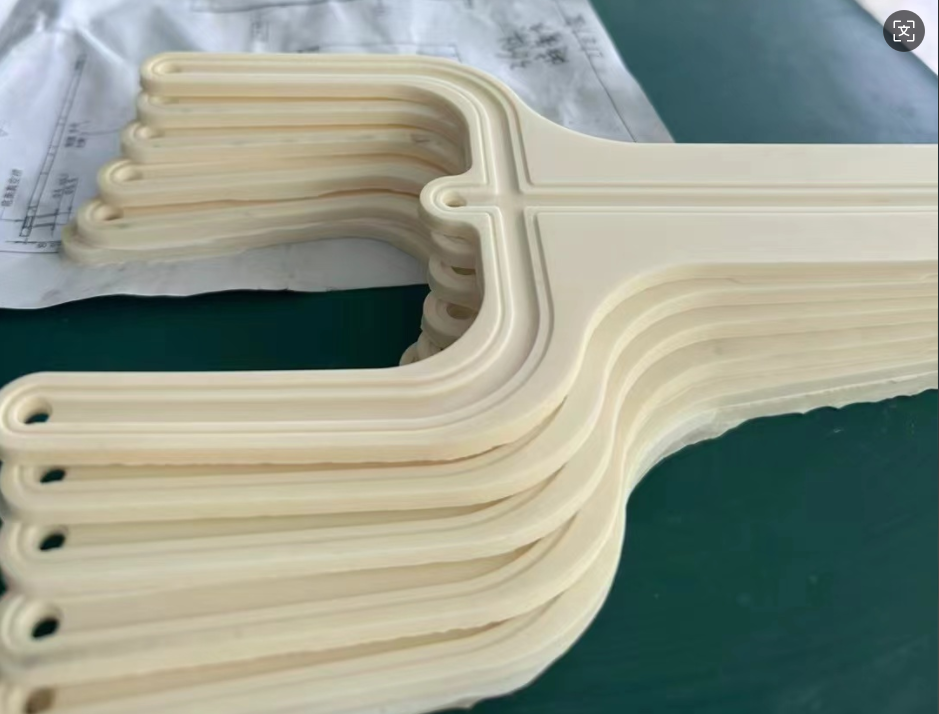
Puwei's Alumina Ceramic Robotic Arm for Precision Wafer Manufacturing is designed to meet and exceed the stringent demands outlined above. It's more than a component; it's a system-critical element built for zero compromise.
Core Technology and Material Superiority
Our arms are fabricated from ≥ 99.6% high-purity Alumina Ceramic, ensuring minimal intrinsic contamination. The material's exceptional properties form the foundation of its performance:
- Unmatched Hardness & Wear Resistance: With a Mohs hardness of 9, it vastly outlasts steel and aluminum in high-cycle applications, protecting your investment in Ceramic Robot End-of-Arm Tooling (EOAT).
- Exceptional Thermal & Dimensional Stability: A low thermal expansion coefficient (6-8 × 10⁻⁶/°C) and high operating temperature (1500°C) ensure the arm performs consistently in varied process environments, from lithography to annealing.
- Inherent Cleanroom Compatibility: The non-porous, polishable surface prevents gas entrapment and particle generation, while its excellent dielectric strength (15-20 kV/mm) safeguards wafers from ESD.
Industry Standards and Puwei's Commitment to Quality
Sourcing for semiconductor equipment requires adherence to rigorous global standards. Key standards include SEMI (Semiconductor Equipment and Materials International) guidelines for materials, cleanliness (e.g., SEMI F72), and dimensional specifications. Our manufacturing philosophy is built around these benchmarks.
Factory Scale & Advanced Facilities
Our production capabilities are a cornerstone of our reliability. Puwei operates a 35,000 sqm dedicated advanced ceramics facility, featuring Class 1000 cleanrooms for final assembly and inspection of critical components like our Ceramic Robot Support structures. This controlled environment is crucial for ensuring the cleanliness levels our B2B clients require.
Product Use, Maintenance, and Best Practices
To maximize the lifespan and performance of your Alumina Ceramic Robotic Arm, proper handling and maintenance are essential.
Installation & Handling Steps:
- Pre-Installation Inspection: Visually inspect the ceramic arm under cleanroom lighting for any transit damage. Use lint-free gloves.
- Secure Mounting: Use the specified torque settings on mounting hardware to avoid imposing uneven stress on the ceramic. Do not overtighten.
- Electrical Isolation Check: Verify that the installed arm is properly isolated if used in an ESD-sensitive configuration.
- Dry-Run Testing: Perform slow-speed, non-production motion cycles to ensure smooth integration with the robot's kinematics.
Routine Maintenance Knowledge:
- Cleaning: Use only approved, high-purity isopropyl alcohol (IPA) and lint-free wipes. Avoid abrasive cleaners or pads.
- Inspection: Periodically check for any chips or cracks, particularly at mounting points or edges. Monitor for any change in system vibration.
- Documentation: Keep a log of service cycles and any environmental changes. The stability of Precision Ceramic Components makes them excellent indicators of other system issues.
R&D and Innovation: Driving Future-Proof Solutions
Our dedicated R&D team, comprising 15% of our workforce, is focused on next-generation solutions. Current innovations include developing graded ceramic-composite structures for even greater strength-to-weight ratios and researching surface functionalization techniques to further reduce particle adhesion for sub-2nm node readiness. This commitment ensures that partners who source our Alumina Ceramic Parts for Automation are investing in a technology roadmap, not just a static product.
Frequently Asked Questions (FAQ)
Q1: How does the weight of an alumina ceramic arm compare to a traditional aluminum one?
A: While alumina ceramic has a higher density (~3.9 g/cm³ vs. aluminum's ~2.7 g/cm³), its superior stiffness (Young's Modulus 300-400 GPa) allows for thinner, more rigid designs. The overall weight difference is often marginal, but the performance in stiffness, stability, and wear resistance is vastly superior.
Q2: Can you customize the Ceramic Robotic Arm for our specific robot model and wafer size?
A: Absolutely. As an experienced OEM/ODM manufacturer, Puwei specializes in custom-engineered solutions. We can design and manufacture arms tailored to your specific kinematic model, wafer size (200mm, 300mm, 450mm), and integration requirements, including features for Vacuum Gripper Ceramic Parts.
Q3: What is the typical lead time for a custom, high-purity alumina robotic arm?
A: Lead times vary based on complexity and certification requirements. For a standard high-purity design, typical lead times range from 12-16 weeks, encompassing precision molding, high-temperature sintering, diamond grinding, and rigorous QA inspection.