


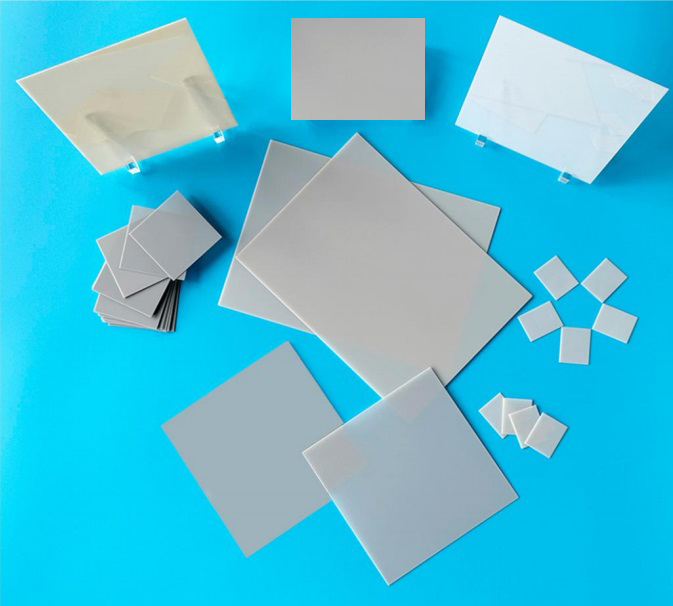
(Thermal conductivity of different ceramic substrate materials)
Unique Advantages of Aluminum Nitride Ceramics
Compared with ordinary alumina (Al2O3) ceramics, aluminum nitride (AlN) ceramics have the following unique advantages:
The biggest advantage of aluminum nitride is its extremely high thermal conductivity.
Its theoretical value can reach 320 W/(m·K), which is 5 to 10 times that of alumina. This means that under the same working conditions, aluminum nitride ceramics can withstand a greater heat flux density. When used as packaging substrates or casings, aluminum nitride ceramics are especially beneficial for the heat dissipation of high-power chips or modules. When made into aluminum nitride metal-ceramic heating elements (Metal-Ceramic Heater), they can achieve rapid heating. When made into aluminum nitride electrostatic chucks (Electro-Static Chuck), they can quickly preheat or heat the adsorbed wafers.
It has a low coefficient of thermal expansion, only 4.3 ppm/K, which is close to that of silicon chips (3.5 - 4.0 ppm/K). This indicates that there is a natural high thermal expansion match between silicon chips and aluminum nitride ceramics, which invisibly improves the reliability of packaging.
In addition, the mechanical properties, electrical properties, and corrosion resistance of aluminum nitride ceramics are comparable to those of alumina ceramics.
Aluminum nitride ceramics can combine high thermal conductivity, low expansion coefficient, high strength, and chemical corrosion resistance, making them an ideal heat dissipation material, especially for applications in large-scale integrated circuits and high-performance electronic devices.
Factors Affecting the Thermal Conductivity of Aluminum Nitride Ceramics
Since aluminum nitride ceramics are insulating solids, the influence of electron and photon heat transfer is extremely small. The main heat conduction mechanism is phonon (lattice vibration) heat transfer. The Al-N bond in aluminum nitride ceramics has relatively high bond energy and a short bond length, so the phonon propagation speed is fast, which is the reason for its high thermal conductivity.
Although theoretically the thermal conductivity of aluminum nitride can reach 320 W/(m·K), currently only a few companies can make the thermal conductivity of aluminum nitride ceramics reach 230 W/(m·K). Usually, the thermal conductivity of actual products is only 150 - 180 W/(m·K). The factors affecting the thermal conductivity of aluminum nitride ceramics are as follows:
From practical experience, the main factors affecting the thermal conductivity of aluminum nitride ceramics include lattice density, oxygen content, purity of raw material powders, and microstructure.
Density
Samples with low density have a large number of pores, which will affect the scattering of phonons and reduce their mean free path, thus reducing the thermal conductivity of aluminum nitride ceramics. Meanwhile, the mechanical properties of low-density samples may also fail to meet the requirements of relevant applications.
Oxygen content
Because aluminum nitride has a strong affinity for oxygen, when aluminum nitride comes into contact with air or water, its surface is easily oxidized and forms an aluminum oxide film, resulting in aluminum vacancies and oxygen defects. Aluminum vacancies and oxygen defects are easy to diffuse into the AlN lattice during the sintering process. After aluminum vacancies and oxygen defects spread throughout the aluminum nitride crystal network, the mean free path of phonons is reduced, leading to a decrease in thermal conductivity.
Lattice defects
Research has found that the types of defects in the AIN (aluminum nitride ceramic) lattice are related to the concentration of oxygen atoms. When the oxygen concentration is lower than 0.75%, oxygen atoms are evenly distributed in the AIN (aluminum nitride) lattice, replacing the positions of nitrogen atoms in AIN, and aluminum vacancies accompany them. When the oxygen concentration is not lower than 0.75%, the positions of aluminum atoms in the AIN (aluminum nitride ceramic) lattice will change, aluminum vacancies disappear, and octahedral defects are generated. When the oxygen atom concentration is even higher, extended defects such as polytypes, inversion domains, and oxygen-containing stacking faults are produced in its lattice.
Measures to Improve the Thermal Conductivity of Aluminum Nitride Ceramics
Firstly, increase the density. Choose fine-grained, high-sintering-activity micro-nano powders, dope with sintering aids, and use high-energy physical-assisted sintering and other methods to improve the sintering density of ceramics.
Secondly, reduce oxygen content and internal defects. Select high-purity, low-oxygen-content raw material powders. The storage of raw material powders and the forming of semi-finished products should avoid the influence of water vapor. During the atmosphere sintering process, the oxygen content should be strictly controlled.