

The relentless pursuit of higher optical power density in applications ranging from industrial cutting and welding to medical therapy and LiDAR places immense thermal management demands on packaging. For procurement managers sourcing critical components for these systems, the choice of substrate material for mounting high-power laser diode bars and chips is not merely a passive decision—it directly determines optical efficiency, wavelength stability, and operational lifetime. 99.6% purity Alumina (Al₂O₃) ceramic substrates have emerged as the industry-preferred thermal and mechanical backbone for this demanding task. This guide explores why this specific material grade is essential and how to specify it for optimal performance and reliability.
The Thermal Management Imperative in Laser Diode Packaging
High-power laser diodes (HPLDs) convert electrical energy to optical energy with typical wall-plug efficiencies of 50-70%. The remaining 30-50% is dissipated as heat, creating an intense localized heat flux at the semiconductor junction. Unmanaged, this heat leads to:
- Thermal Rollover: Output power decreases as temperature rises.
- Wavelength Shift: Emission wavelength drifts, destabilizing the system.
- Catastrophic Optical Damage (COD): Rapid, irreversible failure of the laser facet.
- Reduced Lifetime: Operating temperature is inversely proportional to device lifespan (Arrhenius law).
The substrate's primary role is to spread this concentrated heat laterally and transfer it efficiently to a primary heat sink or cooling system.
Why 99.6% Alumina is the Optimal Choice
While other ceramics exist, 99.6% Al₂O₃ offers a unique, balanced property portfolio specifically suited for HPLD packaging.
1. Optimized Thermal Conductivity (24-30 W/m·K)
This range provides excellent heat spreading capability—far superior to metals like Kovar or CuW in terms of electrical isolation, and significantly better than 96% Alumina. While Aluminum Nitride (AlN) offers higher conductivity (~180 W/m·K), 99.6% Alumina provides a more cost-effective solution for many power levels, especially when combined with a well-designed Direct Bonded Copper (DBC) metallization layer for lateral heat spreading.
2. Exceptional Surface Quality & Flatness
A mirror-polished surface (Ra ≤ 0.5 μm) is not an aesthetic luxury; it's functional. It ensures:
- Intimate Thermal Contact: Minimizes voids and thermal resistance between the laser diode chip/bar and the substrate, whether using solder, eutectic, or epoxy die attach.
- Precision Bonding: Critical for achieving uniform stress distribution and preventing die cracking during thermal cycling.
- High-Frequency Performance: A smooth surface is essential for minimizing signal loss in RF-driven laser circuits.
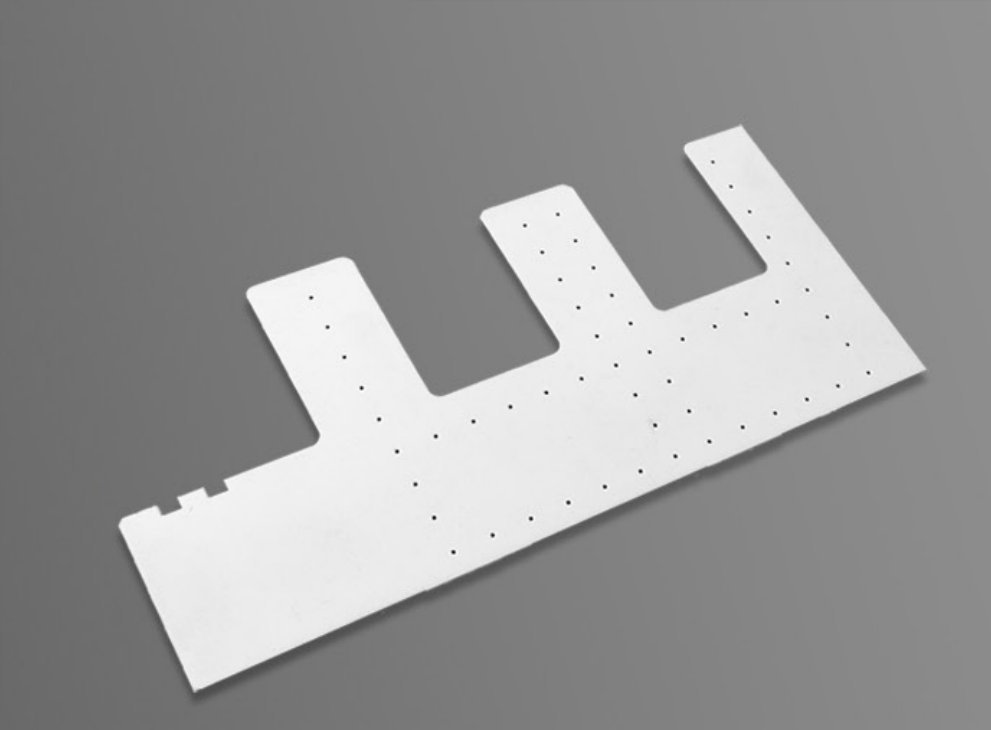
This level of surface finish is a hallmark of a high-quality 99.6% High-purity Polished Grade Alumina Ceramic Substrate.
3. Superior Electrical Insulation & Chemical Inertness
With dielectric strength >15 kV/mm, 99.6% Alumina provides robust electrical isolation, which is crucial for lasers operating at high drive currents and voltages. Its chemical inertness ensures long-term stability, resisting degradation from environmental moisture or fluxes used during assembly, unlike some metallized polymer substrates.
4. Excellent Dimensional Stability & CTE Matching
The low coefficient of thermal expansion (CTE ~7.0 ppm/K) is closer to common semiconductor materials than most metals. When combined with a carefully chosen solder or braze material, it minimizes thermomechanical stress during power cycling, a key factor for long-term reliability in pulsed or modulated laser systems.
Top 5 Sourcing Considerations for Laser Diode Substrates
-
Verified Surface Roughness & Flatness Data
Request profilometer (Ra, Rz) and flatness (camber, warp) reports. For multi-emitter bars or arrays, substrate bow can cause non-uniform contact and catastrophic failure. Suppliers capable of producing large, low-warpage substrates demonstrate advanced process control.
-
Metallization Quality and Adhesion Strength
The metal layer (Au, Ag, AuSn, or Cu) must provide excellent solderability and adhesion. Inquire about the metallization technique (thick-film, thin-film, DBC) and demand peel strength test data (>15 N/cm typical for thick-film Au). Poor adhesion leads to delamination and thermal runaway.
-
Material Purity and Consistency (Color Uniformity)
Iron (Fe) impurities cause reddish discoloration and can degrade thermal and dielectric performance. A consistent, bright white appearance across batches indicates effective impurity control and high, consistent purity. Ask for material certificates (CoA) with elemental analysis.
-
Thermal Performance Characterization
Beyond datasheet thermal conductivity, ask if the supplier provides thermal impedance mapping or can advise on thermal modeling. They should understand the complete thermal path from junction to coolant.
-
Design Support and Customization
Laser packages are highly specialized. Can the supplier provide OEM/ODM services for custom shapes, precise hole patterns for fiber alignment, or intricate DPC (Direct Plated Copper) circuitry for integrated drivers? Their engineering support is vital.
Industry Trends & Technological Drivers
Push Towards Higher Brightness and Efficiency
The demand for brighter sources in projection, pumping, and direct-diode applications drives the need for substrates that can handle ever-increasing heat flux. This is pushing the adoption of composite solutions, like Alumina substrates with integrated DBC copper spreaders or even the evaluation of AlN for the most extreme cases.
Miniaturization and Wafer-Level Packaging
Similar to trends in microelectronics packaging, there is a move towards wafer-level processes for laser arrays. This requires substrates with exceptional flatness and compatibility with semiconductor fabrication tools, an area where polished 99.6% Alumina excels.
Advent of UV and Blue GaN-Based Lasers
The growth of GaN laser diodes for applications from high-density optical storage to sterilization places new demands on packaging materials regarding UV stability and thermal management at shorter wavelengths, reinforcing the need for high-purity, stable ceramics.
Best Practices for Laser Diode Assembly on Alumina
To maximize performance, follow these guidelines during integration:
- Pre-Cleaning: Thoroughly clean the substrate with high-purity solvents (IPA, acetone) in a clean environment to remove organic contaminants.
- Die Attach Material Selection: Choose a solder or epoxy with a CTE that bridges the laser diode material (GaAs, InP, GaN) and the Alumina substrate. AuSn eutectic solder is a common high-performance choice.
- Precise Placement and Reflow: Use precision pick-and-place equipment. Control the reflow profile carefully to avoid thermal shock and ensure void-free bonding.
- Wire Bonding: For electrical connections, use appropriate wire (Au, Al) and bonding parameters to avoid damaging the delicate laser facet or stressing the die attach.
- Hermetic Sealing (if required): For high-reliability applications, the substrate must be compatible with the lid-sealing process (e.g., seam welding, solder sealing).
Relevant Standards and Specifications
Understanding applicable standards ensures quality and facilitates system integration:
- Telcordia GR-468-CORE: Generic Reliability Assurance Requirements for Optoelectronic Devices used in Telecommunications Equipment. Governs reliability testing (thermal cycling, aging).
- MIL-PRF-38534: Performance Specification for Hybrid Microcircuits (General Performance and Quality Requirements). Relevant for military/aerospace laser systems.
- IEC 60747-5: Semiconductor devices – Discrete devices – Part 5: Optoelectronic devices. Provides testing and parameter standards.
- JEITA ED-4701: Test methods for semiconductor lasers. A Japanese standard widely referenced for reliability testing.
- ISO 14644: Cleanroom standards, relevant for the assembly environment to prevent contamination.
FAQ: Sourcing and Using Alumina for Laser Diodes
Q: When should we consider Aluminum Nitride (AlN) instead of 99.6% Alumina?
A: Consider AlN when the laser diode's heat flux exceeds what Alumina can manage, typically for single-emitter chips operating at very high power densities (>500 W/cm²) or where minimal wavelength shift is critical. AlN's higher thermal conductivity (~10x) and better CTE match to some semiconductors come at a significantly higher cost.
Q: What is the impact of substrate thickness on thermal performance?
A: Thicker substrates offer lower thermal resistance in the vertical direction but increase the overall package height and weight. For most applications, a thickness between 0.5mm and 1.0mm provides a good balance. Thinner substrates (e.g., 0.25mm) can be used for extreme miniaturization but require exceptional flatness.
Q: Can we get substrates with patterned metallization for multiple diodes?
A: Yes. This is a core OEM/ODM service. Suppliers can provide substrates with multiple, isolated metal pads for individual diode bars or chips, often using thick-film printing or DPC technology for fine features. This simplifies assembly and improves electrical isolation between emitters.
Q: How do we handle potential electrostatic discharge (ESD) during assembly?
A: Alumina is an insulator. Ensure all handling and assembly is performed in an ESD-safe environment (grounded workstations, personnel wearing wrist straps) to protect the sensitive laser diode from static damage during placement and wire bonding.