

As the global transition to electric vehicles and renewable energy accelerates, the demand for more powerful, efficient, and reliable power electronics has never been greater. At the core of these systems lies a critical component that must withstand extreme thermal cycling, high voltages, and harsh operating conditions: the power module substrate. For procurement managers and design engineers seeking to build next-generation power converters, Active Metal Brazed (AMB) ceramic substrates—particularly those made with Silicon Nitride (Si₃N₄) and Aluminum Nitride (AlN)—have emerged as the enabling technology. This article explores why AMB substrates are becoming indispensable for Silicon Carbide (SiC) and advanced IGBT modules.
The AMB Advantage: Beyond Traditional Bonding
Active Metal Brazing (AMB) is an advanced metallization process that creates a metallurgical bond between copper and ceramic using a reactive braze foil containing active elements like titanium (Ti). Unlike traditional Direct Bonded Copper (DBC), which relies on oxide bonding, AMB forms a chemical bond that is inherently stronger and more reliable, especially with difficult-to-bond ceramics like Silicon Nitride.
Why AMB is Superior for High-Reliability Applications:
- Higher Bond Strength: Peel strength typically exceeds 80 N/cm, compared to 15-25 N/cm for DBC, virtually eliminating delamination risk.
- Superior Thermal Cycling Performance: Capable of withstanding >5,000 cycles (-55°C to 150°C), far surpassing DBC in demanding automotive and industrial environments.
- Excellent Void Control: The vacuum brazing process minimizes voids at the copper-ceramic interface, ensuring optimal thermal transfer.
- Compatibility with Advanced Ceramics: Enables the use of high-performance ceramics like Si₃N₄ that are difficult or impossible to bond with DBC.
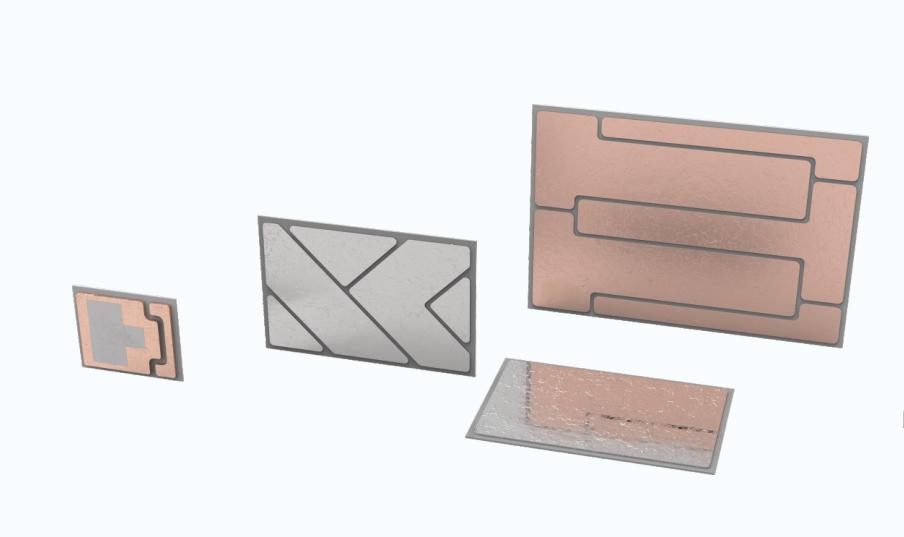
Choosing the Right Ceramic: Si₃N₄ vs. AlN AMB
The choice between Si₃N₄ and AlN as the ceramic base for AMB substrates depends on the specific challenges of your application. Both offer advantages over traditional Alumina (Al₂O₃) substrates.
Silicon Nitride (Si₃N₄) AMB: The Toughness Champion
Si₃N₄ AMB substrates excel in applications where mechanical reliability under extreme stress is paramount.
- Exceptional Fracture Toughness: 6-8 MPa·m¹/² (compared to 3-4 for Al₂O₃) provides outstanding resistance to crack propagation.
- Excellent CTE Match to SiC: 3.2 ppm/K for Si₃N₄ vs. 3.7 ppm/K for SiC, minimizing thermomechanical stress in WBG power modules.
- High Flexural Strength: >900 MPa, making it 3-5 times stronger than Al₂O₃.
- Ideal for: Automotive traction inverters (especially 800V architectures), high-vibration industrial drives, and aerospace power systems.
Our Si₃N₄ AMB Copper-clad Substrate for SiC Modules is engineered specifically for these demanding applications.
Aluminum Nitride (AlN) AMB: The Thermal Performance Leader
AlN AMB substrates prioritize maximum heat dissipation for the highest power density applications.
- Superior Thermal Conductivity: 170-200 W/m·K (compared to ~25 W/m·K for Al₂O₃ and ~90 W/m·K for Si₃N₄).
- Good CTE Match: 4.5 ppm/K, still providing reasonable matching to SiC and excellent matching to GaN.
- Excellent Electrical Insulation: High dielectric strength and low dielectric loss.
- Ideal for: Ultra-high-power-density modules, RF power amplifiers, and applications where thermal management is the primary constraint.
Our Aluminum Nitride Ceramic AMB Copper-clad Substrate delivers this premium thermal performance.
Primary Application Domains
AMB substrates are enabling technologies across multiple high-growth sectors:
- Electric Vehicle Powertrains: Main inverters, DC-DC converters, and onboard chargers, particularly for 800V architectures using SiC MOSFETs.
- Renewable Energy: Solar inverters and wind power converters where long-term reliability in outdoor environments is critical.
- Industrial Motor Drives: High-power variable frequency drives (VFDs) for manufacturing, mining, and HVAC systems.
- Rail Transportation: Traction converters for electric trains and trams.
- Uninterruptible Power Supplies (UPS): High-reliability data center and industrial backup power systems.
5 Critical Sourcing Considerations for AMB Substrates
-
Reliability Data and Field Performance History
Request comprehensive power cycling test reports (e.g., following AQG324 automotive standard) and thermal shock test data. For automotive applications, verify the supplier has experience with the required qualification tests and can provide field reliability data from similar applications.
-
Material Quality and Consistency
The performance of AMB substrates is highly dependent on ceramic quality. Ensure the supplier uses high-purity, consistent ceramic materials with certified properties. For Si₃N₄, verify fracture toughness values; for AlN, confirm thermal conductivity measurements. This level of quality is similar to what's required for other critical Electronic Ceramic Products.
-
Bond Integrity and Void Analysis
The AMB bond interface must be virtually defect-free. Ask for ultrasonic scan (C-Scan) images showing void distribution. Acceptable void percentages should be below 1-2% for automotive-grade substrates. Also verify peel strength test results (>80 N/cm is typical for high-quality AMB).
-
Design Support and Customization Capability
Power module designs are highly specialized. Evaluate whether the supplier can provide comprehensive OEM/ODM services, including custom substrate shapes, complex copper patterning, integrated thermal vias, and assistance with thermal and mechanical simulation. Their ability to work with your specific DBC or AMB design requirements is crucial.
-
Supply Chain Resilience and Automotive Compliance
For automotive applications, verify IATF 16949 certification. Assess the supplier's production capacity for scaling with your volume requirements and their raw material sourcing strategy. A vertically integrated manufacturer with control over ceramic production and metallization processes typically offers better consistency and supply security.
Industry Trends and Technology Drivers
Transition to 800V EV Architectures and Wide Bandgap Semiconductors
The automotive industry's shift to 800V systems to enable faster charging and higher efficiency is driving adoption of SiC power devices. These devices operate at higher temperatures and switching frequencies, making the superior thermal and mechanical properties of Si₃N₄ AMB substrates essential for reliability.
Demand for Higher Power Density and Miniaturization
The push for smaller, more powerful modules requires substrates that can handle higher current densities and heat fluxes. AMB technology supports thicker copper layers (up to 2mm) for high current capacity while maintaining excellent thermal performance through the ceramic.
Integration and Advanced Packaging Techniques
There is growing interest in integrating more functions within the power module, including gate drivers and sensors. This is driving innovation in substrate design, potentially combining AMB for power devices with DPC technology for fine-pitch control circuits on the same substrate.
Best Practices for Handling and Integration
To ensure optimal performance of AMB substrates in your power modules:
- ESD Protection: Always handle substrates in an ESD-safe environment to prevent damage to sensitive semiconductor devices during assembly.
- Proper Cleaning: Clean substrates with appropriate solvents (IPA) before die attach to remove any contaminants that could affect bonding.
- Thermal Interface Management: When attaching the substrate to a heatsink, use appropriate thermal interface materials (TIMs) and ensure uniform pressure to minimize thermal resistance.
- Avoid Mechanical Stress: Do not subject substrates to bending or torsional stress during handling or assembly, as ceramics are brittle.
- Storage Conditions: Store in a dry, clean environment to prevent oxidation of copper surfaces or contamination.
Relevant Industry Standards and Qualifications
AMB substrates for power modules must meet stringent industry standards:
- AQG 324: Guideline for "Qualification of Power Modules for Use in Power Electronics Converter Units in Motor Vehicles" - the de facto standard for automotive power modules.
- IEC 60747 / IEC 62047: Standards for semiconductor devices and micro-electromechanical devices, relevant for packaging and reliability testing.
- JEDEC Standards: Such as JESD22 for reliability test methods (thermal cycling, power cycling).
- ISO 16750: Road vehicles - Environmental conditions and testing for electrical and electronic equipment.
- UL 94: Standard for flammability of plastic materials, relevant for overall module safety.
Frequently Asked Questions (FAQ)
Q: When should we choose Si₃N₄ AMB over AlN AMB?
A: Choose Si₃N₄ AMB when your primary concern is mechanical reliability under extreme thermal cycling or in high-vibration environments (e.g., automotive traction inverters). Its superior fracture toughness and excellent CTE match to SiC make it ideal for these conditions. Choose AlN AMB when maximum heat dissipation is the priority for very high power density designs, especially if using GaN devices or operating at extremely high frequencies.
Q: What are the typical copper thickness options for AMB substrates?
A: AMB technology supports a wide range of copper thicknesses, typically from 0.3mm to 2.0mm. Standard offerings often include 0.3mm/0.3mm (top/bottom) or 0.8mm/0.3mm configurations. Thicker copper allows for higher current carrying capacity but may require design adjustments for etching finer features. Custom thickness combinations are often available through OEM/ODM services.
Q: How does the cost of AMB compare to DBC?
A: AMB substrates are typically 1.5x to 3x more expensive than equivalent DBC substrates due to the more complex vacuum brazing process and often higher-cost ceramics (Si₃N₄, AlN vs. Al₂O₃). However, for applications where reliability is critical (automotive, aerospace, industrial), the Total Cost of Ownership (TCO) is often lower due to significantly longer lifetime, reduced warranty claims, and higher system efficiency enabled by better thermal performance.
Q: Can AMB substrates be used for high-frequency RF applications?
A: Yes, particularly AlN AMB substrates. AlN's excellent thermal conductivity combined with its good dielectric properties (low loss tangent) makes it suitable for high-power RF applications. The thick copper layers achievable with AMB also benefit RF designs by reducing conductor losses. For the most demanding RF circuits, DPC technology might be preferred for its finer feature capabilities, but AMB offers advantages for higher power levels.
Key Capabilities to Look for in an AMB Supplier
Selecting the right AMB substrate partner requires evaluating several critical capabilities:
- Vertical Integration: Control over ceramic powder formulation, shaping, sintering, and metallization processes ensures consistency and traceability.
- Advanced Manufacturing Equipment: Including vacuum brazing furnaces with precise temperature and atmosphere control, advanced patterning and etching capabilities, and comprehensive inspection systems (ultrasonic scanning, X-ray, etc.).
- Material Science Expertise: Deep understanding of ceramic properties, braze alloy formulations, and their interactions under thermal and mechanical stress.
- Quality Management: Certifications such as IATF 16949 for automotive, ISO 9001, and robust process control with statistical methods.
- Application Engineering Support: Ability to collaborate on thermal and mechanical design, provide simulation support, and assist with failure analysis.