

The relentless drive for higher power density, faster signal speeds, and greater reliability in modern electronics is fundamentally reshaping substrate technology. At the heart of this evolution lies a critical process: metallization. For B2B procurement managers in Europe and America sourcing components for power devices, RF systems, and microelectronics packaging, understanding the nuances between Molybdenum-Manganese (Mo-Mn), Direct Bonded Copper (DBC), and Direct Plated Copper (DPC) techniques is essential for making informed, cost-effective, and performance-driven decisions. This article provides a comprehensive comparison of these three pivotal technologies and a strategic framework for selection.
Metallization Defined: The Vital Bridge Between Ceramic and Circuit
Metallization is the process of applying a conductive metal layer onto a ceramic substrate. This layer serves as the foundation for electrical interconnections, heat spreading, and mechanical attachment for semiconductor dies and passive components. The chosen technique directly impacts the final module's thermal performance, current-carrying capacity, power cycling reliability, and overall cost structure. The three dominant methods—Mo-Mn, DBC, and DPC—each offer a distinct set of trade-offs.
An Overview of the Three Core Techniques
- Mo-Mn (Molybdenum-Manganese): A traditional, high-temperature fired process where a Mo-Mn paste is screen-printed and sintered at ~1500°C, forming a robust chemical bond with the alumina. It is renowned for its exceptional adhesion strength and reliability, forming the base for subsequent plating (e.g., nickel, gold).
- DBC (Direct Bonded Copper): A process where a copper foil is directly bonded to a ceramic substrate (typically Al2O3 or AlN) at a high temperature (1065°C) in a nitrogen atmosphere containing a controlled amount of oxygen. The resulting interface is a copper-oxygen eutectic, yielding very high thermal conductivity and current-carrying capacity.
- DPC (Direct Plated Copper): A relatively newer technique where a thin seed layer is sputtered onto the ceramic, followed by photolithography to pattern the circuit and then electroplating to build up the copper thickness. It offers the highest resolution for fine-line circuits.
Latest Industry Technology Dynamics
The current trend is towards application-specific optimization rather than a one-size-fits-all approach. For high-frequency modules and RF power amplifiers, there is a growing preference for AlN ceramic substrates with DBC metallization due to their superior thermal performance. Simultaneously, the rise of wide-bandgap semiconductors (SiC, GaN) is pushing the limits of DBC and DPC to handle extreme heat fluxes. In sensor packaging and MEMS applications, DPC is gaining ground for its ability to create intricate, high-density interconnects on small, complex substrates.
5 Critical Concerns for European & American Procurement Managers
When evaluating metallization options and suppliers, procurement managers should focus on these five decision-driving factors:
- Thermal Performance Requirements: What is the power density (W/cm²)? For very high heat dissipation, DBC on AlN is often unbeatable. For moderate needs, Mo-Mn on alumina may be perfectly adequate and more cost-effective.
- Current Carrying Capacity & Circuit Design: Does the application require thick copper (≥ 100µm) for high current? DBC excels here. Does it require very fine lines/spacing (<100µm) for signal routing? DPC is the preferred choice.
- Adhesion Strength & Reliability Under Stress: Will the assembly undergo severe thermal cycling or mechanical shock? The chemical bond of Mo-Mn metallization and the eutectic bond of DBC typically offer superior long-term adhesion compared to the adhesion of plated copper in DPC, which is more dependent on the quality of the seed layer.
- Cost vs. Performance Trade-off: DPC, with its additive process and photolithography, is generally more expensive for simple, large-feature designs. DBC and Mo-Mn offer better economies for power substrates. The total cost must include the yield and assembly compatibility.
- Supplier's Process Mastery & Quality Control: Each technique has critical process windows. For DBC, controlling oxygen content is key to avoiding delamination. For Mo-Mn, the firing profile determines adhesion. For DPC, seed layer adhesion and plating uniformity are critical. Assess the supplier's statistical process control (SPC) data.
Deep Dive: Puwei's Expertise Across Metallization Techniques
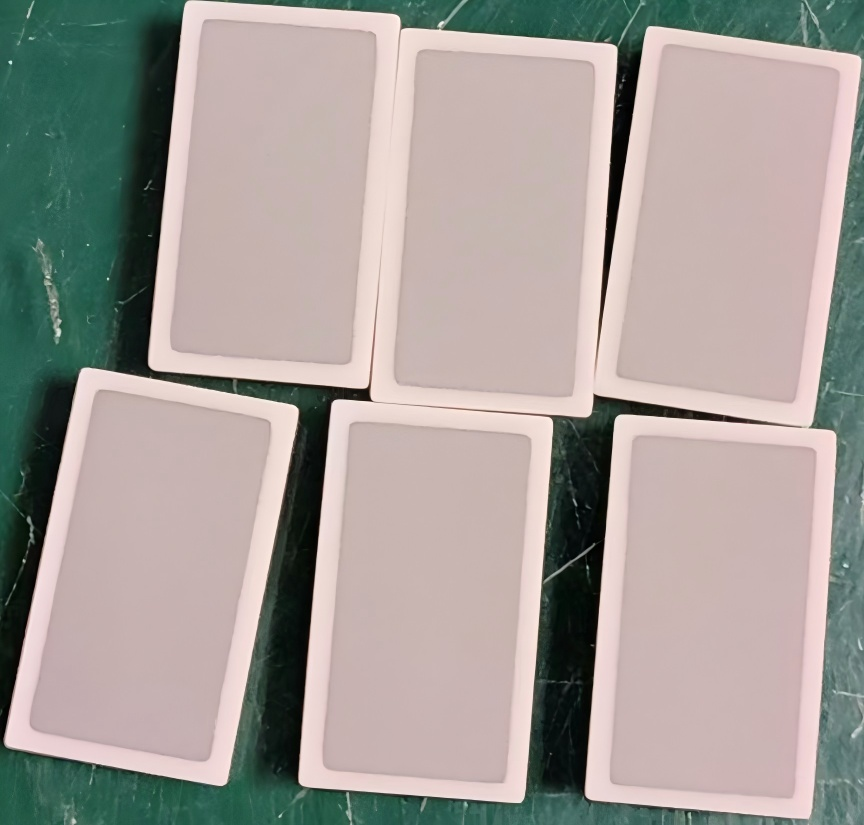
1. Alumina Ceramic Molybdenum Manganese (Mo-Mn) Metalized Substrate
Puwei's Mo-Mn metalized substrates represent the gold standard of reliability for demanding applications. This technology is ideal for high-voltage power devices, RF circuits, and as a robust platform for thick film hybrid microcircuits.
Key Advantages & Applications:
- Exceptional Bond Strength: Adhesion strength >70 MPa ensures survival under thousands of thermal cycles.
- Excellent High-Frequency Performance: The fired molybdenum layer provides a stable, low-loss surface for microwave components.
- Cost-Effective for Medium-to-High Volume: Screen printing is highly efficient for standardized patterns.
- Versatile Plating Base: The Mo-Mn layer is an ideal substrate for subsequent nickel and gold plating, facilitating wire bonding and soldering.
2. Direct Bonded Copper (DBC) Metallization of Alumina Substrate
Our DBC technology is the solution of choice for applications where thermal management is paramount. By bonding thick copper (typically 0.1mm to 0.6mm) directly to alumina or AlN, we create substrates with unparalleled heat spreading capabilities for IGBT modules, automotive power converters, and high-brightness LED packaging.
Key Advantages & Applications:
- Superior Thermal Conductivity: The direct, void-free bond provides minimal thermal impedance.
- High Current Capacity: The thick copper layer can carry hundreds of amperes.
- Excellent Power Cycling Reliability: The CTE of copper is well-matched to solder, reducing stress in large-area die attachments.
- Design Flexibility: The copper can be pre-shaped or chemically etched into complex circuits.
3. Direct Plated Copper (DPC) Capabilities
While the initial product description focuses on Mo-Mn and DBC, Puwei's advanced manufacturing portfolio also encompasses DPC processes for niche, high-precision applications requiring the ultimate in design resolution.
Industry Standards & Manufacturing Excellence at Puwei
Quality in metallized ceramics is governed by standards such as MIL-PRF-55342 for hybrid circuits, IPC-2221 for design, and various ASTM standards for adhesion and thermal testing. Puwei's manufacturing philosophy integrates these benchmarks into a robust quality management system.
State-of-the-Art Facilities
Our capability to master multiple metallization techniques is backed by significant infrastructure. Puwei operates dedicated, climate-controlled production bays for thick-film firing (Mo-Mn), high-temperature DBC furnaces with precision atmosphere control, and cleanrooms for sputtering and plating processes (DPC). This integrated facility allows us to recommend and produce the optimal solution without technological bias, ensuring our clients in the OEM/ODM sector get the best technical and commercial outcome.
R&D Focus: Innovating at the Interface
Our R&D team, comprised of materials scientists and process engineers, dedicates significant resources to advancing metallization technology. Current projects include developing ultra-high adhesion seed layers for DPC on AlN, optimizing DBC processes for next-generation silicon carbide power modules, and creating novel alloy pastes for Mo-Mn to enhance solderability and reduce processing temperatures.
Product Use, Handling, and Assembly Guidelines
Proper integration is key to realizing the performance of metallized substrates.
General Handling & Storage Steps:
- Incoming Inspection: Check for visual defects, contamination, and measure adhesion on a sample basis per agreed-upon AQL levels.
- Cleaning: Clean substrates just before use. For Mo-Mn and DBC, a solvent clean (IPA) is often sufficient. For DPC, follow the supplier's recommendation to avoid damaging thin features.
- Baking (if required): For hermetic packaging or to remove moisture before soldering, bake at the recommended temperature (e.g., 125°C for 2-4 hours).
- Die Attachment & Soldering: Use solder preforms or paste with a melting point suitable for the application. Ensure the thermal profile does not exceed the substrate's maximum temperature or degrade the metallization.
- Wire Bonding: For Mo-Mn with Ni/Au plating and DBC/DPC with plated surfaces, standard gold or aluminum wire bonding parameters apply. Conduct bond pull tests to validate.
Key Reliability Considerations:
- Thermal Cycling: Understand the CTE mismatch between the ceramic, metal layer, and attached components. Design the assembly to minimize stress.
- Humidity Resistance: For non-hermetic applications, ensure the final conformal coating is compatible with the metallization to prevent galvanic corrosion, especially on DBC.
- High-Temperature Storage: Verify with the supplier the long-term aging characteristics of the metal-ceramic interface at your maximum operating temperature.
Frequently Asked Questions (FAQ)
Q1: For a new 10 kW automotive inverter module, which metallization technique should I prioritize?
A: For this high-power, high-reliability application, Direct Bonded Copper (DBC) on an AlN ceramic substrate is typically the leading candidate. It offers the best combination of thermal conductivity (to cool the SiC or IGBT dies), high current capacity for busbars, and proven reliability under automotive-grade thermal cycling. Mo-Mn would be insufficient for the thermal demands, and DPC's copper thickness may be limiting for the current.
Q2: Can DBC be used for fine-pitch RF circuits?
A: DBC has limitations for fine features. The etching process for thick copper foil results in significant undercut, limiting the minimum trace/space width to typically >200µm. For fine-pitch RF circuits or high-frequency modules, Mo-Mn with subsequent thin-film patterning or DPC are superior choices, as they can achieve line widths and spacings below 50µm.
Q3: How does the cost structure compare between Mo-Mn, DBC, and DPC for medium-volume production?
A: As a general rule for medium volumes: Mo-Mn is often the most cost-effective for standard patterns requiring good reliability. DBC costs more due to the cost of thick copper foil and the precise furnace process but is justified by its thermal performance. DPC is typically the most expensive on a per-substrate basis due to the vacuum equipment and plating time involved, but it can be economical for very complex, small substrates where it minimizes waste and enables high integration, as seen in advanced sensor packaging.